A useful press kit lets a programmer or communications team describe your film accurately without asking you to reconstruct basic information. It is different from the film submission itself and from a screening delivery package. The checklist below is VIA Editorial’s suggested working method, not a universal entry rule or a promise of selection.
1. Make one film fact sheet the source of truth
Record the exact title, director’s preferred credit, completion year, runtime including credits, original language, available subtitle languages and the production contact. Use the same spelling in the film, submission form and publicity material. Add a version date so an organiser can distinguish an updated sheet from an earlier draft. Do not put a private screener password in a document intended for public circulation.
- Film title and director credit, checked against the final film.
- Runtime, year, original language and available subtitles.
- Public contact email, website if available and one person responsible for updates.
- A separate, private record of the viewing link and access instructions.
2. Write about the story before explaining the tools
Prepare a one-sentence logline and a short synopsis of roughly 50–80 words. A longer version of around 150 words can help when a form allows more space. These are convenient working lengths, not festival limits. Lead with a person, a situation and a consequential choice; avoid replacing the story with a list of software names.
For an invented example, “An AI-generated journey through memory” describes a theme but gives a reader little to picture. “A night-shift archivist discovers that deleting a damaged recording also erases her brother’s last message” establishes a character and a conflict. A synopsis can then explain what she tries and what stands in her way. Mark a version that reveals the ending clearly, and supply it only when requested.
3. Choose stills that remain useful outside your timeline
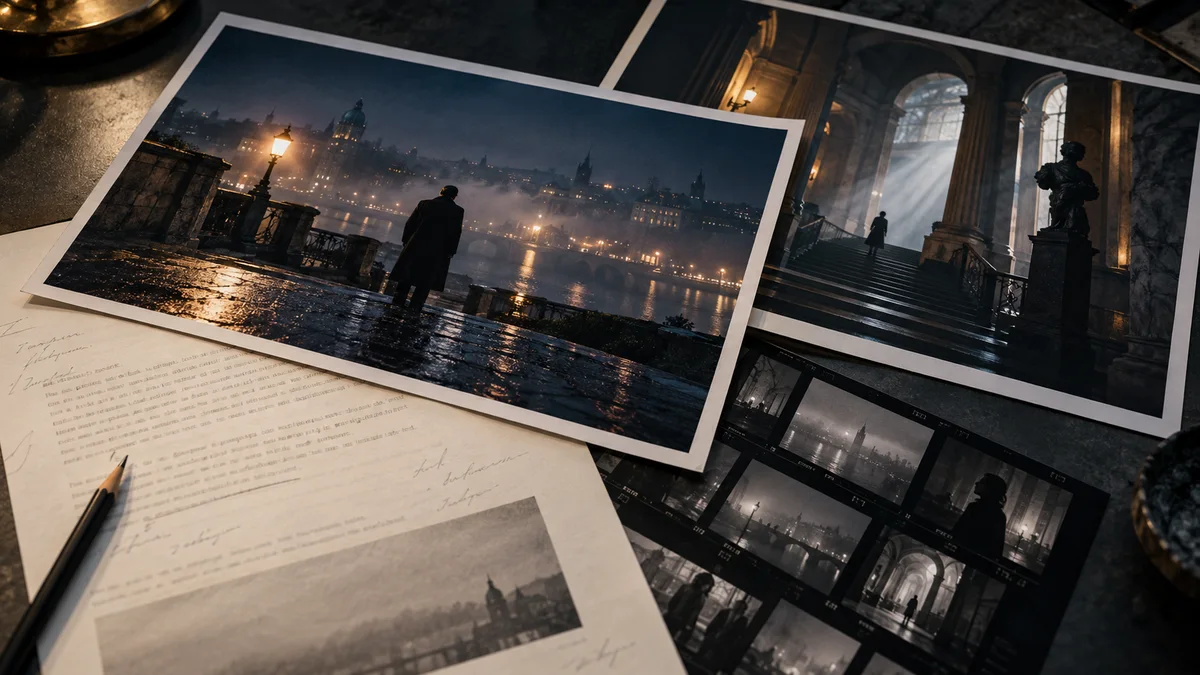
Start with three to five actual frames: one that establishes the world, one that shows a character or relationship, and one with a distinct visual situation. Choose images that remain legible at small size. A title card can supplement this set but rarely tells the whole story. Do not present a newly generated promotional image as a frame from the finished film.
Supply clean images without festival laurels or text overlays unless those are explicitly requested. Keep a short caption and the agreed credit beside each filename. For example: “Night Archive — still 02 — Mara at the listening desk — image courtesy of the production.” Use a separate poster file. Check the recipient’s requested dimensions before creating extra crops; the original still should remain available.
4. Keep credits, biography and process note distinct
Confirm names and roles with collaborators before sharing the kit. Write a brief biography that helps an unfamiliar reader understand the filmmaker’s practice, without inventing awards or screening history. A separate process note can explain human creative decisions and where AI was used, if the festival asks for it. Prompt2Screen already has a dedicated guide to explaining an AI film process; this kit should point to that note rather than overload the synopsis.
5. Adapt the kit to the event and edition
Keep a simple submission record: event, edition, proposed category, official rules URL, date checked, requested materials and status. A draft kit can be ready while a call is still awaiting details. Do not treat preparation as evidence that submissions are open.
As checked on 20 October 2026, the Florence AI Festival homepage links to its FilmFreeway submission page. The Milan AI Festival competition page lists categories but says opening dates, deadlines, fees, full rules and the submission link will be announced. Follow each destination’s current instructions rather than transferring requirements between festivals.
The Rome AI Festival site presents the third-edition results, while Prompt2Screen presents films from its completed Torino edition. Those are useful viewing references, not proof of a current submission window. VIA — Visual Innovation Awards connects these projects, but each event’s awards and selection process must be checked separately. The VIA network guide explains the different formats.
6. Test the handoff as a recipient
Open the shared folder from an account that has only the access you intend to grant. Check that the fact sheet, still captions and contact details are understandable without your explanation. Keep editable working files apart from the approved public kit. If something changes, replace the approved version deliberately and tell any organiser already using the old material.
A useful final test is simple: can someone who has never met you identify the film, describe its story, credit the people involved and contact the right person? If so, the kit is doing its job. It supports a clear introduction to your work; the film and the festival’s selection criteria still determine the next step.