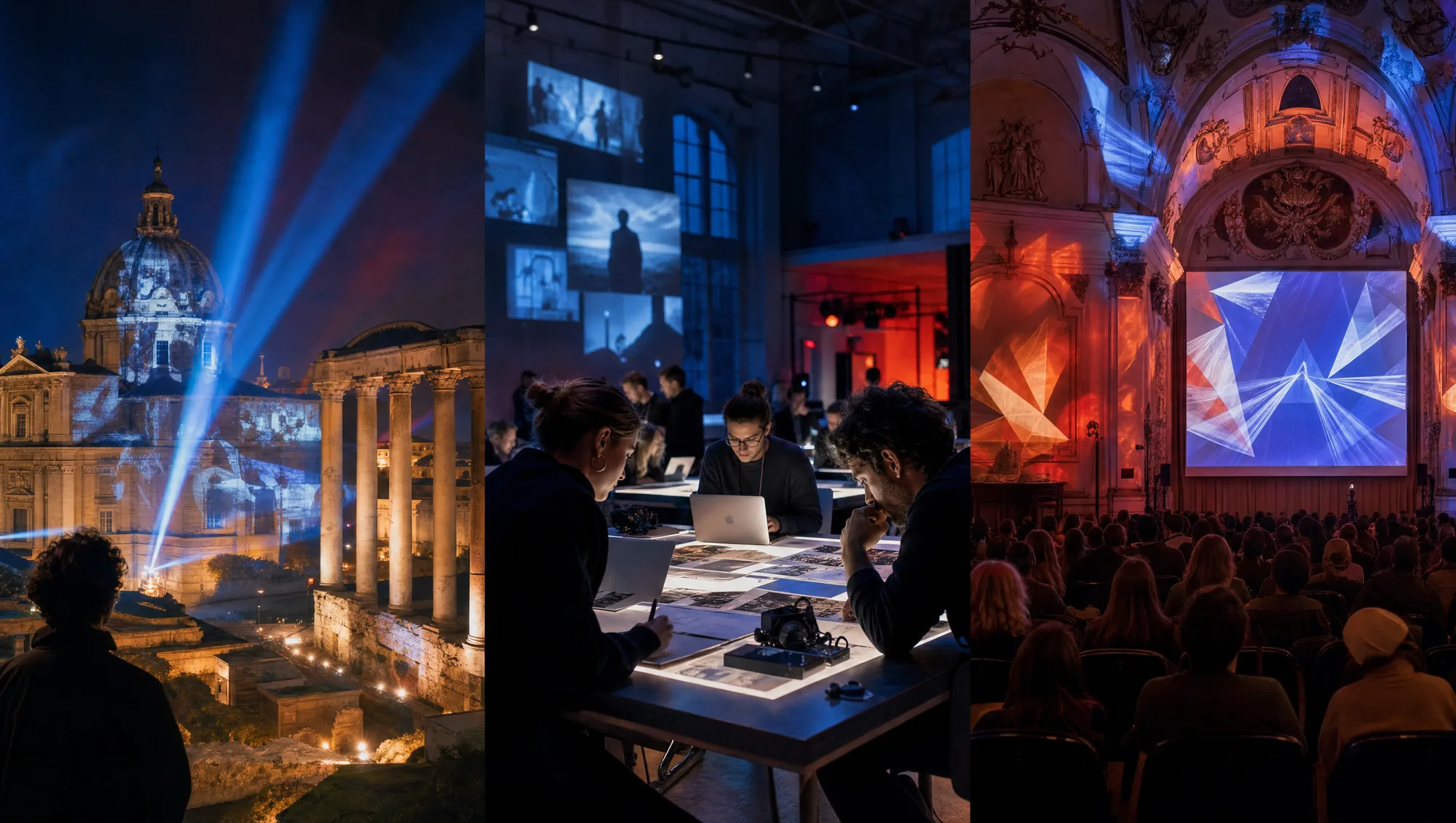
Start with a curatorial question, not a list of tools
“Films made with AI” identifies a production approach, but gives the audience little help in understanding why these works belong together. Try a narrower question: how does a place change when it is remembered, imagined or rebuilt? A documentary, a fictional journey and an abstract film could all address that question without resembling one another.
Write a two-sentence programme statement before assembling a shortlist. The first sentence names the question; the second explains what different perspectives the selection will bring. Use it as an editing tool. If a film is impressive but has no clear relationship to the question, save it for another programme rather than stretching the explanation.
Build a shortlist that makes the choices visible
Use one row per candidate film. Record the title, credited filmmaker, exact runtime including credits, spoken language, available subtitle versions, a one-sentence account of its contribution, and the contact responsible for confirming the screening. Keep viewing notes separate from facts supplied by the filmmaker.
- Write what the film contributes to this programme, rather than a general verdict such as “strong visuals”.
- Record tonal intensity and potentially sensitive subject matter so you can plan audience information and the sequence.
- Ask for the intended screening version and confirm the proposed use with the filmmaker or authorised contact. A publicly watchable link is a discovery source, not a screening booking.
- Mark missing information as unresolved. Do not promise a film in public copy before its participation is confirmed.
This is an editorial working sheet, not a competition scorecard or a substitute for an organiser’s published requirements. A small selection with a clear argument is more useful than a longer list assembled only to fill a slot.
Use the VIA archives as a starting point for discovery
The Prompt2Screen collection records ten films made by ten teams in under ten hours for the Automotive brief in Torino on 10 October 2026. That completed edition offers a concrete example of a shared starting constraint. When exploring it for a future programme, ask how different responses might speak to your audience; do not assume that a past screening makes a new one automatic.
The Rome AI Festival website presents the third edition’s winners and links to its film catalogue. Treat this as an archive of the September 2026 edition. Awards can help a viewer discover work, but a prize is not the curatorial reason to include a film in every subsequent programme.
VIA’s Makers Era project at Google Cloud AI Live Roma illustrates a different setting: a custom visual project alongside six Rome AI Festival shorts selected jointly by VIA and the Google Cloud team. That confirmed example shows how a selection can sit within a wider event. It does not prescribe the same number of films for another room or audience.
Sequence for contrast and continuity
Try two running orders using the same films. In the first, group similar approaches together; in the second, alternate them. Read each sequence against your programme question. Which transitions make a connection clearer, and which simply interrupt the viewing experience?
An opening film can establish the question without carrying every idea in the programme. A quieter work may need space after a dense or loud one. The final film should leave an image or question worth discussing. These are choices to test, not rules that require the longest or most awarded film to close.
Write a short transition note for each pair: what carries across, what changes, and whether the audience needs context. Avoid introducing an interpretation that reveals an ending. If a connection requires a long explanation, reconsider the pairing.
Give the whole event a time budget
For an illustrative 60-minute session, allocate 3 minutes to welcome and context, 28 minutes to films including credits, 4 minutes across transitions, 20 minutes to discussion and 5 minutes to closing and departure. Those blocks total 60 minutes; they are an example, not a VIA event format or a festival requirement.
Calculate from the actual screening files, not rounded catalogue runtimes. The 28-minute film allowance is a limit, not a target to exceed by borrowing all the discussion time. If your films total 31 minutes, remove or replace a work, shorten another planned segment explicitly, or agree a longer session with the venue.
Keep a run sheet with start time, duration, activity, responsible person and the cue that moves the session on. Agree who handles a missing speaker or playback interruption. Protect the closing time by identifying in advance which optional spoken material can be shortened.
Make the conversation belong to the films
Prepare one opening question about a concrete creative decision: “What changed between the first version and the film we watched?” Follow with a question about a particular edit, sound choice or point of view. Let the filmmaker describe their own process; do not infer a tool or workflow from the look of a shot.
Brief the moderator on the audience and available time. Invite questions that connect to the works, and make space for more than the most confident voice in the room. A discussion of tools can be valuable when it explains a creative decision. It becomes less useful when it replaces the films with a general product demonstration.
Confirm what the audience will actually receive
Before announcing the programme, check titles and credits, final order, language and subtitle information, duration, access arrangements and how audience questions will work. Ask the venue about its delivery and playback requirements. Link to the authoritative event page for booking details rather than copying an unconfirmed schedule into several places.
Within the VIA network, Florence AI Festival and Milan AI Festival maintain their own current festival information. Use those pages for their programmes and participation details; this guide is practical editorial advice, not their selection policy.
For a screening programme or a custom visual project with VIA — Visual Innovation Awards, contact info@viagroup.ai with your audience, purpose, location and available time. A clear brief makes it easier to discuss the films and the experience around them.